‘Oscar Murillo’s Transnational Creativity’ by Claudia Ross
2025
In a swamp, land cedes to water, forming an environment defined – fuelled – by a scrambled mixture of earth and liquid. In Oscar Murillo’s survey exhibition ‘Espíritus en el pantano’ (Spirits in the Swamp) at Museo de Arte Contemporáneo de Monterrey, Mexico, this biodiverse wetland ecosystem becomes a metaphor for the social, political and artistic collectivity that undergirds displaced communities whose stories are both similar to and removed from Murillo’s own. Born in La Paila, Colombia, Murillo and his family emigrated in his youth from the small industrial town to London, joining a large group of La Paila natives in the UK. This relocation, and the impromptu gatherings that resulted from it, reverberate throughout Murillo’s interdisciplinary, collaborative artwork, infusing his practice with all the joyous yet haunting dimensions of a life lived far from home.
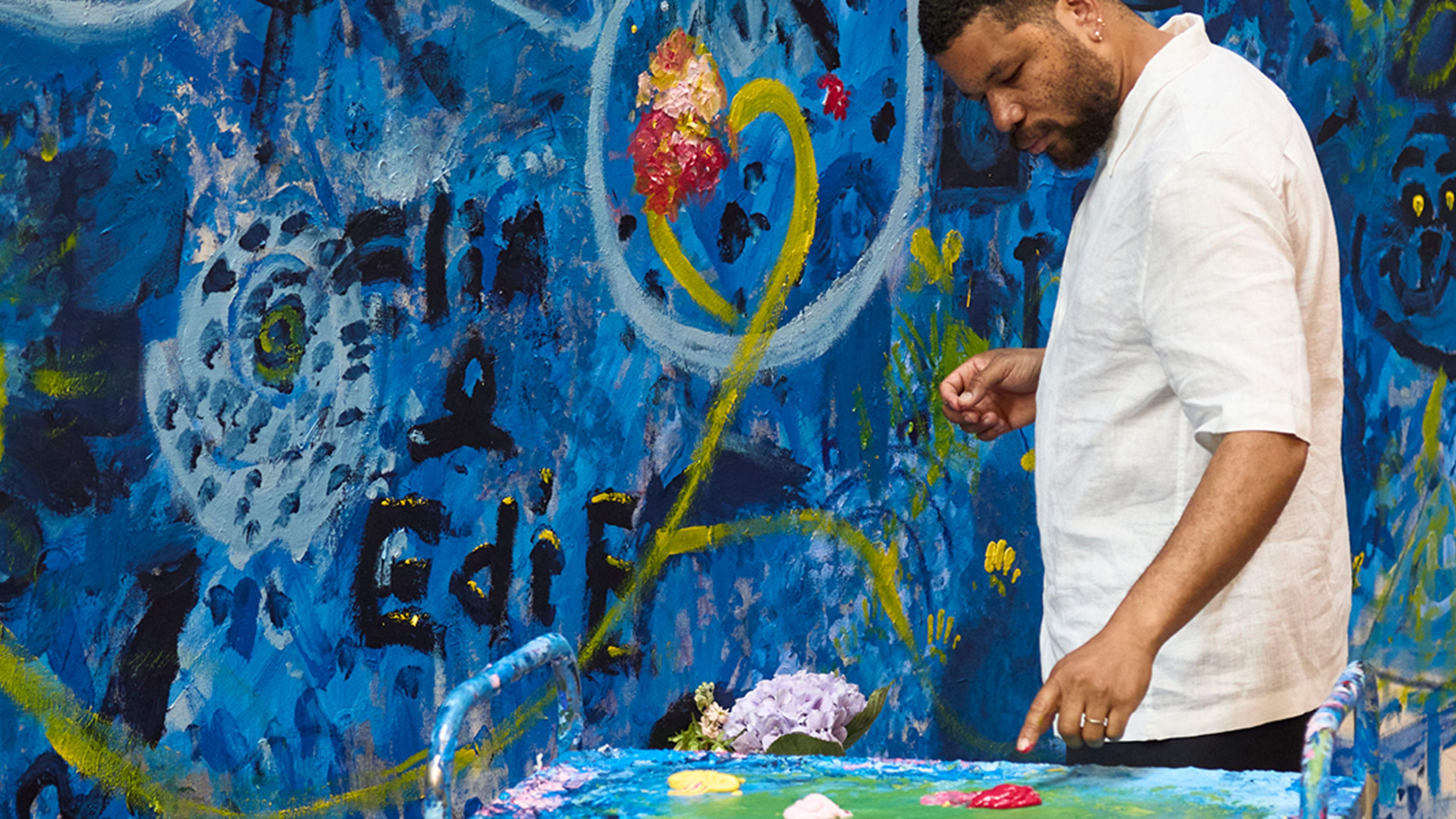
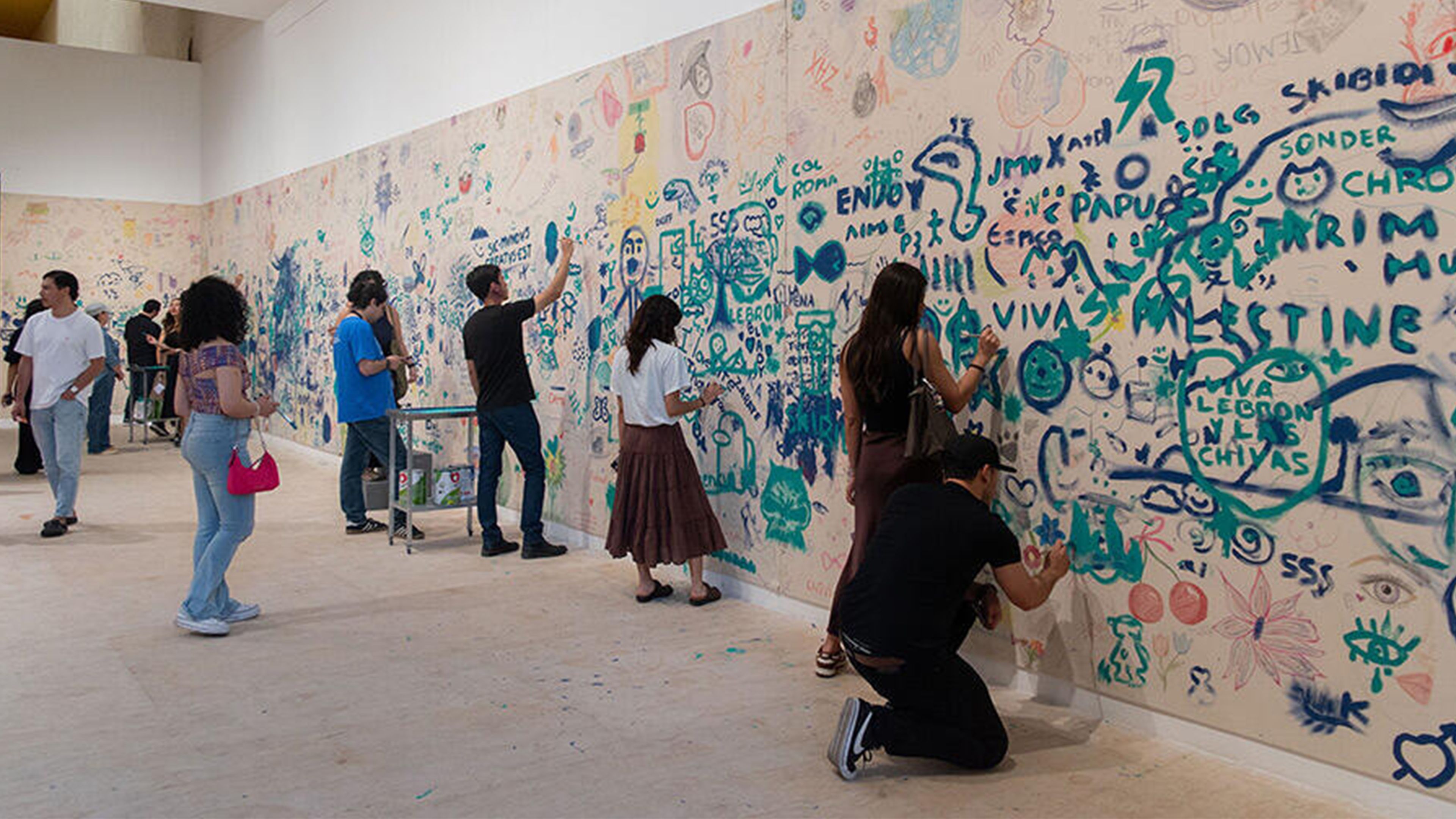
Curated by MARCO director Taiyana Pimentel, Murillo’s exhibition foregrounds shared experience over the typical display of individual artworks – an emphasis that echoes a marsh’s symbiotic habitats. There are no paintings on the walls, which are instead lined with a mural that was collectively drawn prior to the opening by a variety of participants. Now, the canvas is reserved for further decoration by museum visitors during free-entry days every Wednesday and Sunday. Multilingual phrases and playful drawings, applied in brightly coloured acrylic, are layered to infuse the galleries with the swampy feel of the exhibition’s premise (Espíritus en el pantano, 2024–25). In two primary installations, white plastic chairs are laden with materials symbolic of civic defiance. Rocks crafted from cement and masa (maize dough) rest on several of the seats in one untitled site-specific work, as though waiting to be thrown, while Mesmerizing Beauty (2025) presents a similar grouping of chairs, this time holding paintings from Murillo’s series ‘study for social cataracts’ (2021–22), raised aloft by wooden supports like placards at a protest.
These meeting spaces, though, feel both jubilant and fractured. In THEM (2012–24), cathode ray television sets feature clips from Murillo’s life in La Paila, New York and London – people dancing, a crowded ferry to the Statue of Liberty – positioned with each monitor facing a different direction, so that this array of scenes can never be viewed in totality, if at all (one of the TVs showed white static, another simply turned off). Eerie reminders of Murillo’s home town infuse Human Resources (2017), a video work in which a man performs Colombian cumbia songs to a group of mateos – traditional effigies burnt as part of New Year’s rituals – that are self-portraits of local workers, many of which sport uniforms emblazoned with the logos of multinational companies. Staged in a bare office space illuminated by fluorescent lights, the singer serenades the ghostly crowd as though they were family or friends.
Read more at Frieze.