5–6/F, H Queen’s, 80 Queen’s Road Central, Hong Kong
November 24, 2026–March 6, 2027
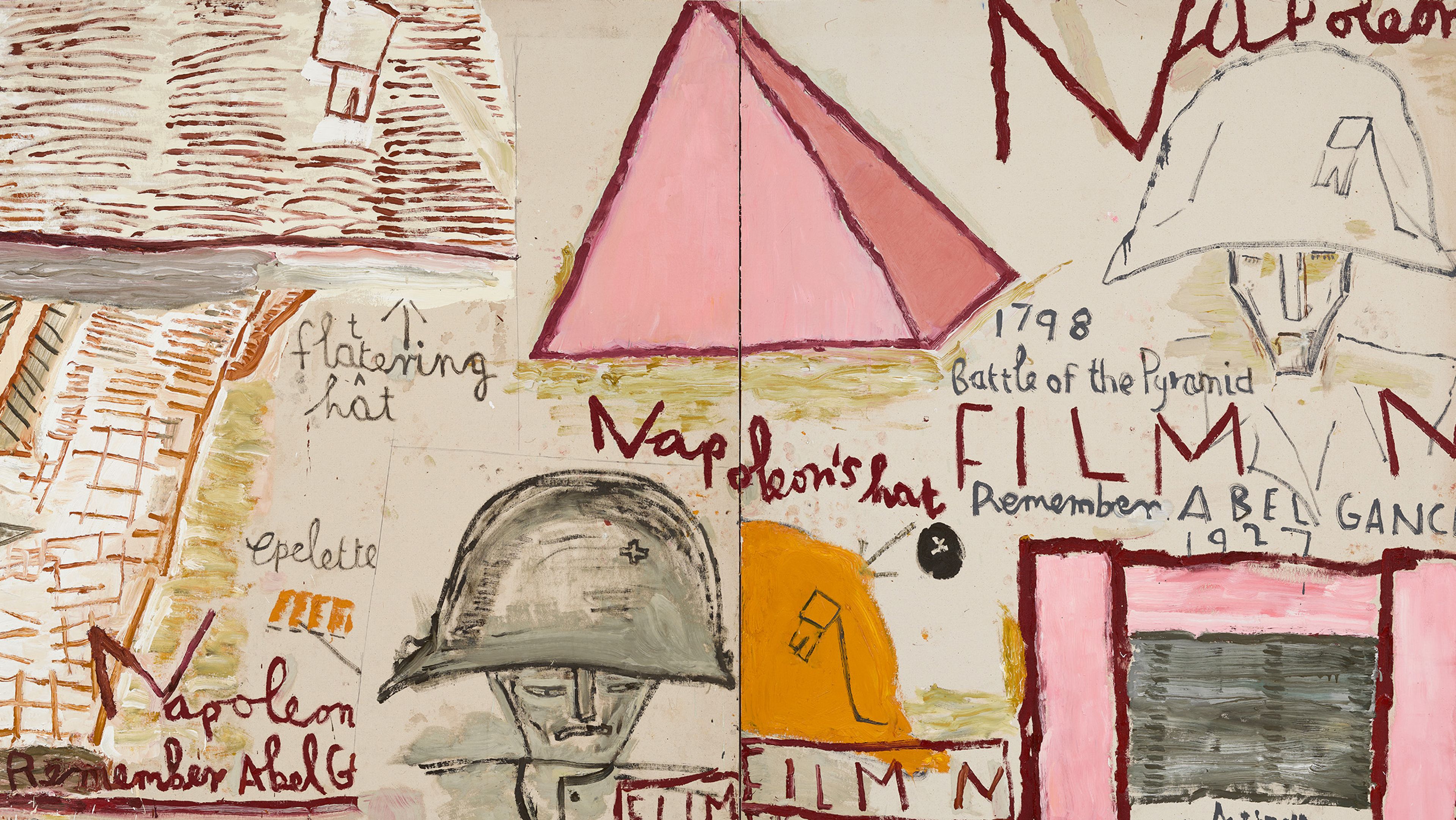
David Zwirner is pleased to announce Napoleon and Wild Flowers, an exhibition of work by British artist Rose Wylie at the gallery’s location in Hong Kong. This presentation includes new and recent canvases, historical and multipanel paintings, and works on paper that together embrace Wylie’s tendencies toward striking contrasts and adventuresome composition. Napoleon and Wild Flowers marks the artist’s second solo show with the gallery in Hong Kong and follows her largest-ever survey presentation, Rose Wylie: The Picture Comes First, at the Royal Academy of Arts, London, in 2026. This exhibition is a continuation of Rose Wylie: Henri, Egypt...Bette, Bear, which also took place at David Zwirner Paris this year.
Wylie has become known for her uniquely recognizable, colorful, and exuberant compositions that appear aesthetically candid, not seeming to align with any discernible style or movement, but on closer inspection are revealed to be wittily observed and subtly sophisticated meditations on the nature of visual representation itself. The artist has long been interested in exploring perspectival and compositional strategies other than—and along with—traditional Renaissance perspective, frequently making numerous iterations of a given motif as a means of advancing her formal investigation. Working in both single- and multipanel formats, she regularly juxtaposes apparently disparate imagery, creating visual rhymes and resonances that coalesce into a unified composition.
The title for this exhibition is taken from a new body of work by Wylie—a series of paintings depicting wildflowers that appear as enlarged botanical drawings—and a 2026 diptych that revisits her impressions of the Ridley Scott–directed biopic Napoleon (2023). In Napoleon and Wild Flowers, the artist celebrates her affinity for distinct contrasts by pairing this image of the namesake nineteenth-century French emperor, who is often identified with ambition and domination, with subject matter that has seemingly opposite associations. In a group of six new paintings and accompanying works on paper, Wylie magnifies her source material to larger-than-life proportions to confer prominence and status to common wildflowers.
At six feet high, each painting in the new series portrays one flower at the heart of its composition. For the background of each work, Wylie applied very thick layers of paint to build up a satiny smooth surface that appears like icing on a cake, against which she further highlights the unique qualities of the individual plants. The artist paints from memory and from life—a bunch of fritillaries that were gifted to her by a friend, the red fruit of the wild cherry tree in her garden—and from art history. She references sixteenth-century German botanical drawings or the miniatures in the fifteenth-century illuminated manuscript Très Riches Heures du Duc de Berry. Though Wylie’s flowers are graphically rendered to showcase their allure, delicacy, and resilience, the images retain a certain amount of realism in the specific characteristics of and variations between the plants. In this series, as in other paintings such as the historical work Blackberry Leaf (1997), Wylie acknowledges the beauty of these everyday wildflowers by elevating the unrefined attributes of these plants and other elements of natural life over what is mass-produced or assembled artificially. Charting the development of Wylie’s recurring images and compositional style, Blackberry Leaf predates her wildflower series and calls attention to her longstanding interest in the natural world. Focusing instead on the leaf over the flower or fruit of the plant, Wylie sets the spiny, almond shape against a lined background, transferring to canvas the composition of a drawing that she completed first on ruled paper.
In other exhibited works, Wylie meditates on impressions from her personal life, popular culture, and the public realm, assimilating diverse imagery and signs into her singular pictorial world. The title of Under the Sea (2020) riffs on lyrics from the Beatles song “Octopus’s Garden,” one of the only hits written by Ringo Starr, and the composition features his and John Lennon’s initials inscribed at the top as well as the swimmers suspended mid-current. The painting points to Wylie’s lifelong love of swimming and the sea, which she sees as having a metaphysical element, free from the laws of gravity and both an end and a beginning. In White Building (2022), Wylie paints the exterior of her seventeenth-century house in Kent, England, on the right panel, and on the left, the titular white structure from the 1965 spaghetti western film For a Few Dollars More. The two adjoined buildings present a kind of positive and negative image of each other. Underneath, Wylie inscribes another reference to a filmic western, Mel Brooks’s 1974 satire Blazing Saddles; rifles and green dollar-bill signs create further links between both movies across the two panels.
A dreamlike still life, A White Pedestal Dish (2025), which was also shown at David Zwirner Paris, spotlights an intimate domestic interior scene. The diptych Mary and Philip and Little Rose (Hall) (2025) also pictures the inside of the artist’s home—reorganizing and distorting the architectural space in a kind of cubist mode—as well as her twenty-one-year-old granddaughter, who is also called Rose. On the left side, mapping an “escape route” across time and space, the artist depicts Mary Tudor, who reigned outright as the first queen of England from 1553 to 1558, and her husband, Philip II. Wylie used the queen’s wedding portrait as source material for her painting, emphasizing here the king’s thin legs, out of proportion with the rest of his body, and the small dog at their feet. In the historical painting Sitting on Bench, Red Shadow (2007), she also eschews literality and recalls the presence of a particular character. Paying tribute to a scene from Pedro Almodóvar’s 2006 film Volver, Wylie portrays Raimunda, played by actress Penélope Cruz, sitting on a bench, in profile. The artist paints Cruz’s noteworthy attributes—wolf hair, slim legs—in such a way that “makes something emblematic,” in Wylie’s words.
Rose Wylie (b. 1934) studied at Folkestone and Dover School of Art, Kent, England, and the Royal College of Art, London, from which she graduated in 1981. The artist’s first solo exhibition took place in 1985 at the Trinity Arts Centre, Kent. She has had solo presentations at venues including the Rosenwald-Wolf Gallery, University of the Arts, Philadelphia (2012); Jerwood Gallery, Hastings, England (2012); Tate Britain, London (2013); Haugar kunstmuseum, Tønsberg, Norway (2013); Städtische Galerie Wolfsburg, Germany (2014); Douglas Hyde Gallery, Dublin (2015); Space K, Seoul (2016); Chapter Arts Centre, Cardiff, Wales (2016); Turner Contemporary, Margate, England (2016); Serpentine Gallery, London (2017); Plymouth Arts Centre and The Gallery at Plymouth College of Art, England (an exhibition that traveled to Newlyn Art Gallery & The Exchange, Cornwall, England); Centro de Arte Contemporáneo de Málaga, Spain (2018); and The Gallery at Windsor, Vero Beach, Florida (2020).
In 2020, where i am and was, the artist’s first solo museum presentation in the United States, was on view at the Aspen Art Museum in Colorado. Also in 2020, the solo exhibition Hullo Hullo Following-on was on view at the Hangaram Art Museum, Seoul, before traveling to the Aram Nuri Arts Center, Goyang, South Korea, in 2021. A solo exhibition of the artist’s work was on view at the Museum Langmatt, Baden, Switzerland, in 2021. In 2022, the Stedelijk Museum voor Actuele Kunst (S.M.A.K.), Ghent, presented the exhibition picky people notice…. And in 2025, Zentrum Paul Klee in Bern organized Rose Wylie: Flick and Float, which was followed by a solo exhibition of Wylie’s work, The Picture Comes First, on view in the Main Galleries at the Royal Academy of Arts, London, in 2026.
Wylie is the recipient of the John Moores Painting Prize, presented by the Walker Art Gallery, Liverpool, in 2014, and the same year was also elected a senior academician to the Royal Academy of Arts. In 2015, she received the Royal Academy of Arts’ Charles Wollaston Award. In 2018, she received the South Bank Sky Arts Award in recognition of her exhibition at the Serpentine Galleries the previous year and was awarded an OBE (Officer of the Order of the British Empire) for her services to art.
The artist’s work has been represented by David Zwirner since 2017. Wylie’s first exhibitions with the gallery include Horse, Bird, Cat (London, 2016), Lolita’s House (London, 2018), and painting a noun… (Hong Kong, 2020). In 2021, David Zwirner presented Which One, the artist’s first solo exhibition at the gallery’s New York location. The solo exhibition Car and girls was on view at David Zwirner London in 2022, and CLOSE, not too close was presented at David Zwirner Los Angeles in 2023. In 2025, When Found becomes Given was presented at David Zwirner London, and, in 2026, Henri, Egypt...Bette, Bear was on view at David Zwirner Paris. Wylie lives and works in Kent, England.
Wylie’s work can be found in prominent collections throughout the United States, Europe, and Asia, including Arario Museum, Seoul; Hammer Museum, Los Angeles; High Museum of Art, Atlanta; Jerwood Art Foundation, United Kingdom; Museum Ludwig, Cologne; National Museum of Women in the Arts, Washington, DC; Portland Museum of Art, Maine; Royal Academy of Arts, London; Space K, Seoul; Städtische Galerie Wolfsburg, Germany; Stedelijk Museum voor Actuele Kunst (S.M.A.K.), Ghent; Tate, United Kingdom; Walker Art Gallery, Liverpool; and Zentrum Paul Klee, Bern. For all press inquiries, contact: Carol Lo carol@davidzwirner.com