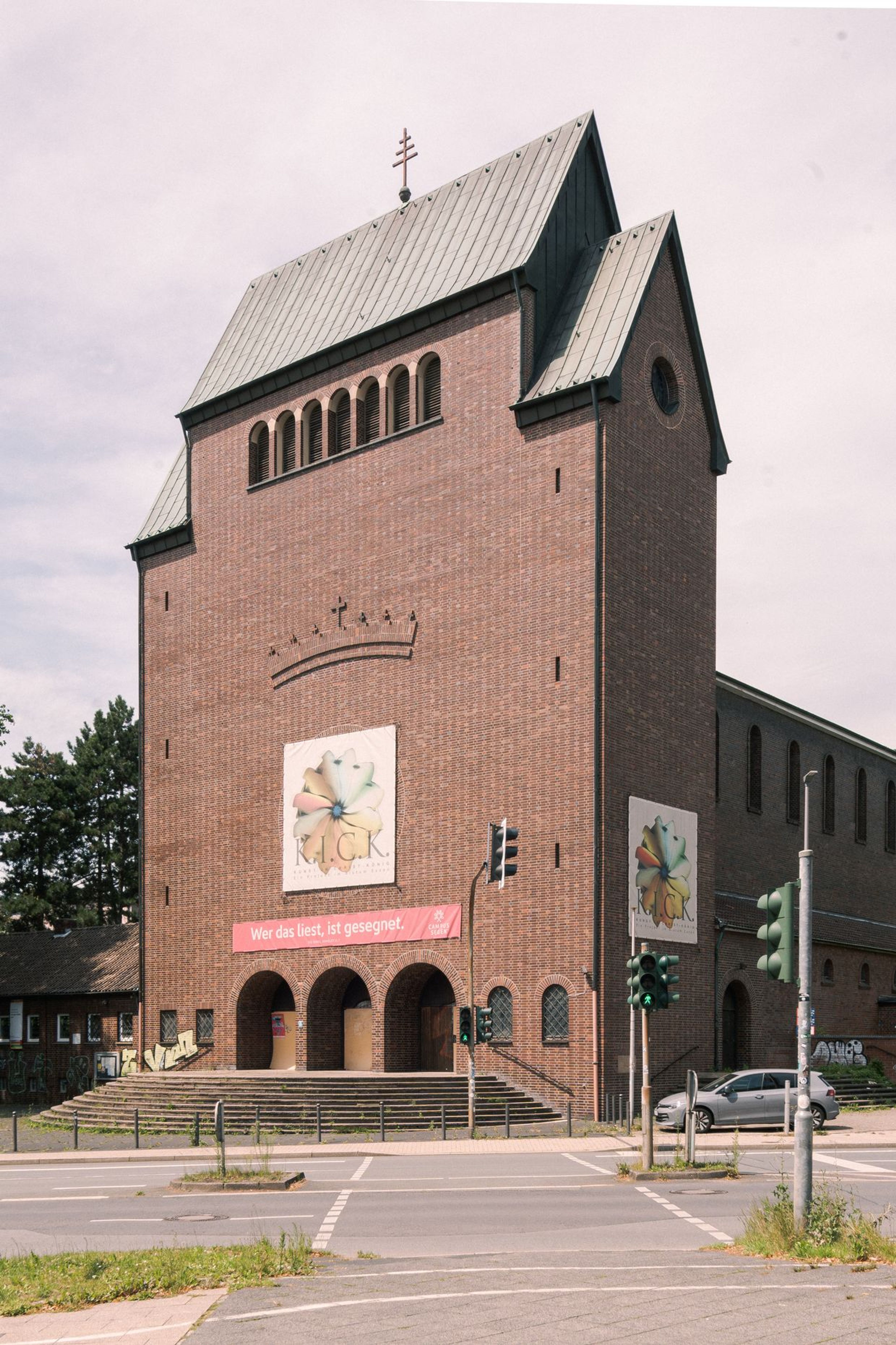
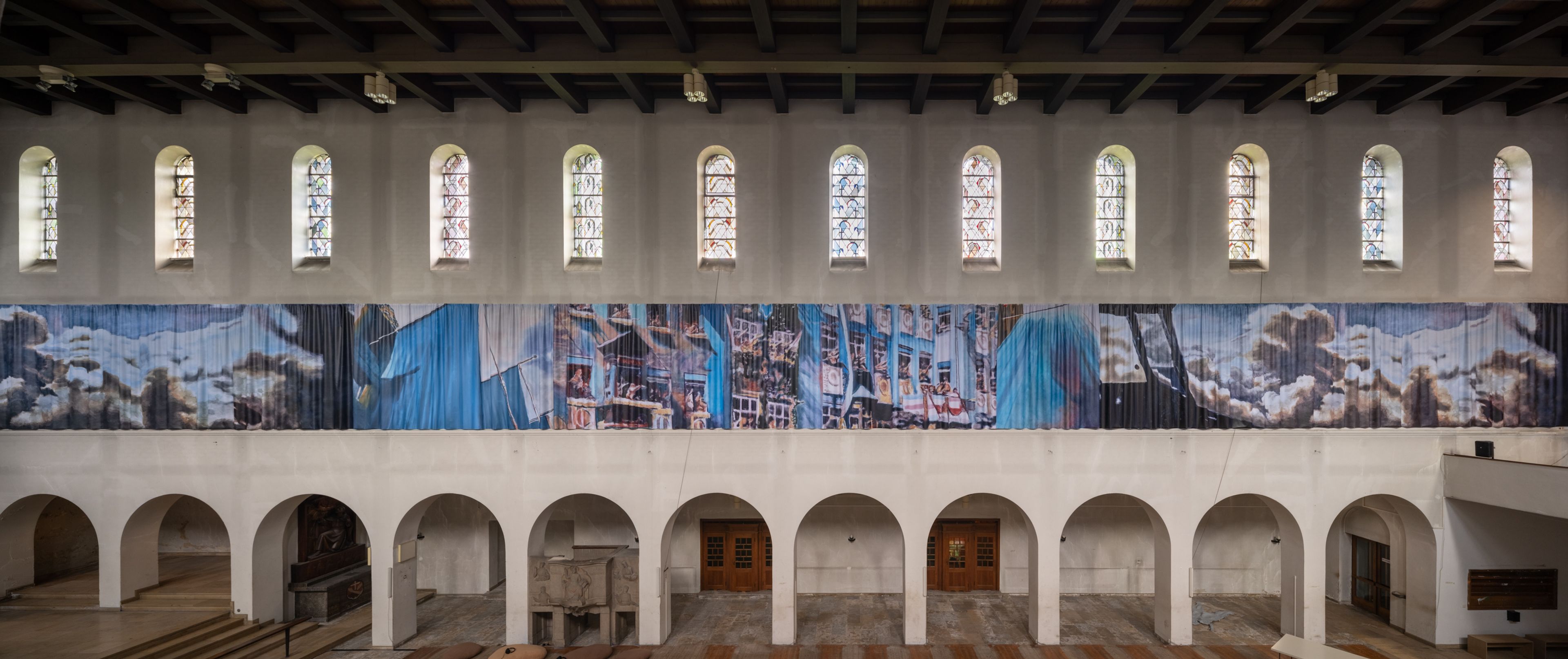
Christ-König Church, Bochum, Germany
June 21–October 4, 2026
Luc Tuymans is included in Manifesta 16 Ruhr, installed across twelve post-war churches in Germany located in Bochum, Duisburg, Essen and Gelsenkirchen.
The central theme of Manifesta 16 Ruhr is rooted in the historical and architectural legacy of post-war religious buildings. These buildings, often representing modernist or brutalist architectural styles, are now largely abandoned due to declining religious engagement. The biennial aims to repurpose and rethink these structures into civic and cultural spaces that foster dialogue, community cohesion and artistic innovation.
Tuymans's work is on view at the Christ-König Church (1932 by Franz Schneider) in Bochum, which is a reconstruction of a church originally built for a Franciscan monastery. Tuymans presents printed curtains with images from the 1935 German Nazi propaganda film Triumph of the Will, remastered and colored so all the red flags become blue.
Tuymans states, “1932 was a historical flashpoint and the final year of the Weimar Republic. A church from this period stands as a silent witness to how fascist aesthetics hijacked sacred spaces and rituals to create a cult of personality [...] In Leni Riefenstahl’s Triumph of the Will everything is framed with quasi-religious incense, suggesting a divine second coming. I came across the film on YouTube in a colourised version in which all the flags were turned blue, which completely changes the impact. I decided to paint some of the film stills, removing every iconic image. What one gets is discolouration as subversion: the blue colour is asserted with calm and neutrality in opposition to the aggressive red. Removing the explicit symbols allows a critique of the aesthetic of authoritarianism itself. The sacralised status of the church and the imagery, stripped of both the holy and ideological power, leaves behind a vacuum. By first having painted the imagery and then having it transferred onto curtain fabric and shown as such, it can be perceived as something domestic, temporary or even theatrical inside a permanent stone structure. With this I wanted to highlight the fragility and critique the false, performative nature of the idea of eternity and the destructive power of fascism.”
Learn more at Manifesta 16 Ruhr.