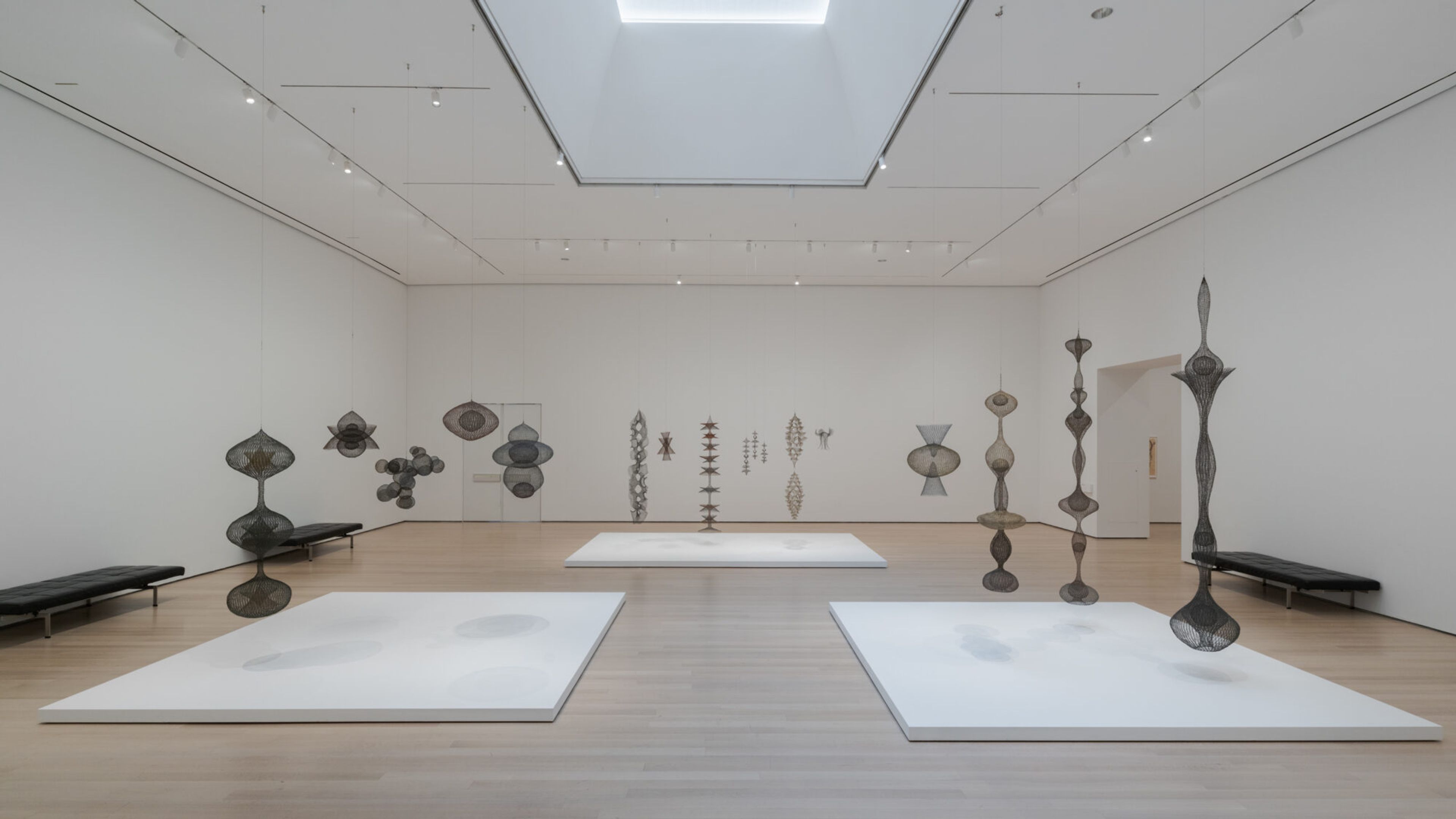
“In Asawa’s hands, wire was transformed from an instrument of imprisonment into a lifeline, a route to imaginative freedom.”—Deborah Solomon
November 2025
Ruth Asawa Turned Wire Into Her Lifeline By Deborah Solomon Ruth Asawa only needed four hours of sleep a night. This was her explanation for how she got so much done. If you roll out of bed at 4 a.m., you can have a few undisturbed hours in your studio before your children (she was married, with six kids) wake up and start asking questions. Maaaa, what’s for breakfast? Where are you?
She was easy to locate; she did much of her artwork in her living room in the Noe Valley neighborhood in San Francisco. We know from photographs that she liked to sit on the floor, cross-legged and within reach of her materials — spools of inexpensive industrial wire. From this hardware-store staple, she spun, loop by loop, inch by inch, fabulous abstract sculptures that hung from the ceiling and mesmerized visitors to her home with their lacy delicacy and wavy, spiraling silhouettes.
Asawa, who died in 2013 at age 87, is currently the subject of a must-see, prodigiously moving retrospective at the Museum of Modern Art. Although overlooked by the art establishment for most of her life, she has garnered star-level magnitude at last, thanks to the efforts of revisionist art historians.