Raymond Saunders’s paintings and assemblages mimic a neglected alley wall festooned with old wheat-paste posters, spray paint, and warning signs now defanged by disfigurement. Saunders’s real goal seems to be the imitation of those unexpected confluences of random signs that present a symbolic or prophetic reading or message. Crosses abound, mostly fabricated by right-angled intersections of colored tape, as in Dr. Jesus (1968), I Don’t Go To Church Anymore (1975), and Harlem (1979), or suggested through the coincidental patterning of a nine-square black-and-white checkered canvas in Used to Be and Now? (2001) or the intersection of a yard stick and an expanse of tape in El Telegrafo (1986). There are also quite a few Virgin Marys and sundry saints, as in Untitled (1987), Flowers from a Black Garden no. 51 (1993), and Untitled (1994). Saunders also includes more personal heroes such as Malcolm X, Ingres, Dürer, and Thelonious Monk, but it is the spiritual imagery that positions his works within a prophetic context—these are not to be confused with the accumulated images of a Rauschenberg or Basquiat. There is also the symbolism of reading signs and symbols in a didactic format—much is made in the wall text (the exhibition was curated by Ebony L. Haynes) of the artist’s tenure as a school teacher in New York, and of the notion that the black canvas is among other things a blackboard. But the blackboard metaphor goes only so far: through Saunders’s lyrical use of texture the black canvases become brick walls, Paleolithic cave walls, or even the anti-art of Stella’s “Black Paintings.”
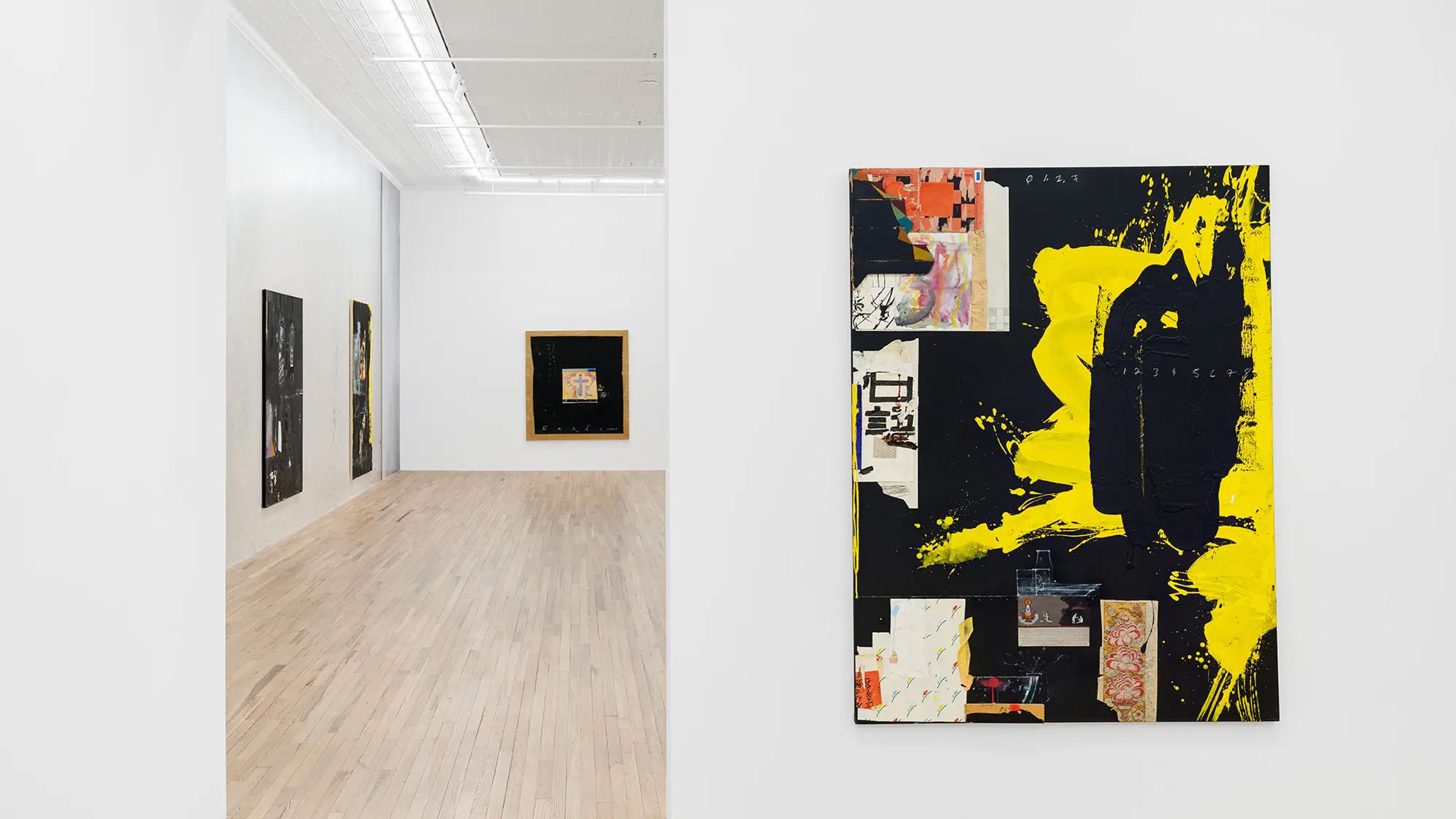
Installation view: Raymond Saunders: Post No Bills, Andrew Kreps Gallery, New York, 2024. Courtesy Andrew Kreps Gallery.